






Introduction of PI

Professor Chang Liu is an Associate Professor and Research Full Professor at the Faculty of Life and Health Sciences, Shenzhen University of Advanced Technology (SUAT). She was awarded the "Hundred Talents Program” of Chinese Academy of Sciences (CAS). Dr. Liu earned her bachelor’s degree from Hebei Normal University. She completed her joint Ph.D. training at the Kunming Institute of Zoology, CAS, and the Max Plank Institute for Neurobiology in Germany. Afterwards, she conducted postdoctoral research under the supervision of Professor Leslie C. Griffith, Fellow of the American Academy of Arts and Sciences, at Brandeis University, USA. she established her independent research group at Shenzhen Institute of Advanced Technology, CAS, while currently holding her academic appointment at SUAT.
Her research focuses on dissecting neural circuits and molecular mechanisms of sleep, learning and memory, as well the exploration of new targets and strategies for the diagnosis, treatment, and intervention of sleep disorders and cognitive decline. Relevant research findings have been published in internationally renowned journals such as Nature, PNAS, Current Biology, Journal of Neuroscience, eLife, and npj Parkinson’s Disease, with over 20 papers published to date. Her work has received funding support for over 10 projects from including the National Natural Science Foundation of China (NSFC), the “Pioneer Initiative” Talent Introduction Program of CAS, Guangdong Basic and Applied Basic Research Foundation, and Shenzhen-Hong Kong Institute of Brain Science and Innovation sub-project. She has applied over 20 patents. One has been translated into practical application, which optimizes and upgrades scientific research instruments related to cognitive function assessment. She has also provided relevant technical guidance to multiple research institutions and universities.
Research Area
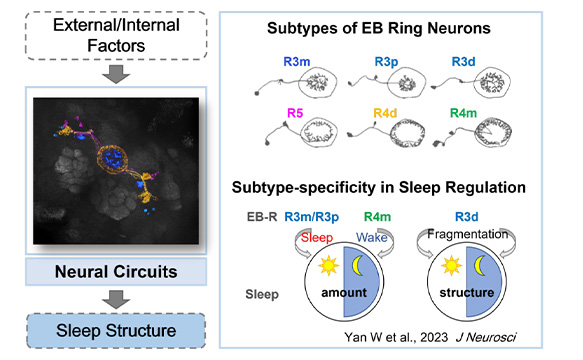
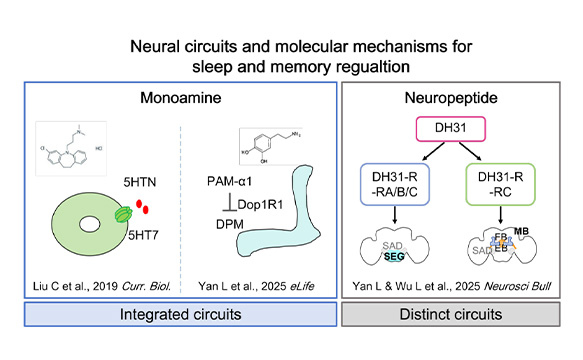
Sleep and memory are time-dependent, complex, and important physiological functions. Memory and sleep are inextricably linked: cognitive deficits are often associated with sleep disorders (such as Alzheimer's disease), and sleep abnormalities can cause functional deficits at the molecular, cellular, physiological, and cognitive levels. Although memory formation has been shown impaired after sleep deprivation, more evidence support memory consolidation is attributed to sleep. However, the spatiotemporal co-regulation of memory coding and sleep is still difficult, and the biological basis of sleep and memory, especially the integrated circuit mechanism is still unclear. To study the molecular and cellular basis of the interaction between sleep and memory, and to explore new targets and strategies for diagnostic and therapeutic interventions for sleep disorders and cognitive decline, we use Drosophila melanogaster as the primary animal model and apply multidisciplinary approaches, including behavioral, genetic, anatomical, and imaging techniques, and utilize cross-cutting and advanced scientific research platforms to investigate the same questions through cross-species validation.